Publication date: June 1, 2026
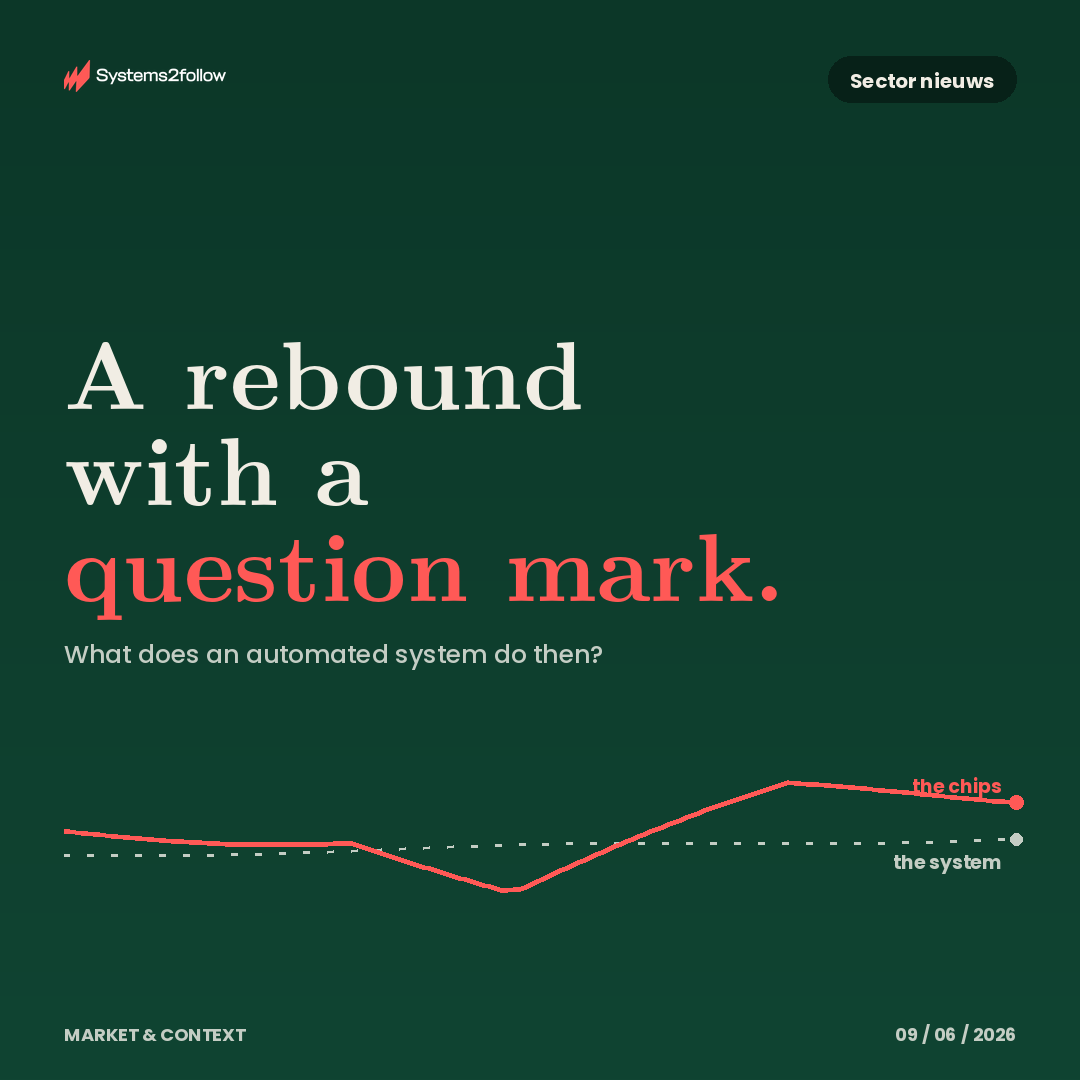
Last week we asked the question of whether the chip rally is a bubble. This week, the market itself asks a new question, and the answer changes by press release.
European stock markets opened the week in the plus, not because a quarterly figure came out better or a central bank made a decision, but because investors were betting on a possible extension of the cease-fire in the Middle East. The AEX is again chafing against its records, around 1,042 points. The price of oil moves with every new sound from the region. Across the ocean, the S&P 500 (~7,560 points) and the Nasdaq (~26,900 points) are at or just below their records.
The striking thing: much of that movement hangs not on numbers, but on an expectation of what politicians will do. And somewhere in a group app, someone types, "Should I respond to this, or not?"
What is actually going on?
We are currently seeing a market that reacts strongly to news rather than fundamentals. A report about a possible deal, and the stock market turns green. A disappointing headline a day later, and the same gains can evaporate.
That kind of movement is called "headline-driven," or in other words, driven by headlines. They have two annoying characteristics. They are hard to predict, because no one knows in advance what a bargaining chip will yield. And they can be sudden, because the news often comes out of stock market hours, so the market opens at a different level first thing in the morning.
For an investor who follows the news closely, this is debilitating. Every headline feels like a signal to do something. And precisely that feeling, that you have to react, is where it goes wrong.
How does an automated system respond to the news?
The short answer: it doesn't. An automated system does not read the newspaper, watch the news or have an opinion on geopolitics. It sees one thing: the price, and how it moves.
That sounds like a flaw, but it is a conscious choice. A headline is a story, and a story may or may not be true. A price is a fact. The system does not wait for the explanation of why the market moves; it responds to the movement itself, according to rules that are predetermined.
As a result, a system does not run ahead of the music. It does not buy on a rumor or sell out of fear of a headline that may never become true. It waits until the movement becomes visible in the price, and then acts as planned.
News does hit the system, but by a different route

Yet it is too easy to say that news leaves a system cold. It affects the system indirectly, namely through volatility: the degree to which prices shoot back and forth.
When the market hangs on the news, the outcomes become larger and more erratic. Good systems notice that and adjust accordingly. Not by forming an opinion about the news, but by scaling back risk when volatility increases: smaller positions, wider margins, or sitting on the sidelines for a while. The system doesn't say "this is going wrong," it says "it's unsettled here, so I'm taking less risk one step at a time." That's risk management, not prediction.
That's also the difference with the average investor. Whereas a human will act more when there is turmoil, a good system often does the opposite: calm down until the picture is clear again.
The biggest pitfall this week: trading upside down

It is tempting to act on news like this. One thinks, "If that deal goes through, things will skyrocket, I'm stepping in now." The other thinks, "If it goes wrong, everything collapses, I'll take profits off." Both reactions are human. And both gamble on the outcome of something no one has control over: a political decision.
That's exactly why our clients choose automated investing. Not because a system is smarter than a human, but because it doesn't participate in the impulse to react to every headline. If the news goes the other way, it's not a disaster for the system, just a new price to react to according to the rules. What can be a disaster though: getting in there with a gut feeling that in hindsight turned out to be based on a press release that was outdated after only a day.
What this means for you
Whether the cease-fire will hold and fuel the rally, or whether it will backfire and the market will take a step back, none of us knows. What you can do, however, is arrange your investments so that the answer to that question becomes less of a nightmare.
That means not moving with every headline, not overriding your systems based on a gut feeling, and letting rules devised and tested by traders who make it their business to do the work. A market that hangs on the news is precisely the market where discipline makes all the difference.

.jpg)