Publication date: June 9, 2026 - Category: Market & Context
In one weekend, the chip sector lost about a tenth of its value. In doing so, it pulled the Nasdaq to its worst day in more than a year, and within one trading day everything largely bounced back. Broadcom posted record sales and was punished anyway. Nvidia announced a new collaboration on memory chips and led the recovery. And tomorrow morning comes the U.S. inflation figure. Somewhere in a group app, someone types the same question as always: "Should I do anything now?"
The honest answer is almost always: probably not, and certainly not impulsively. What we can do, however, is explain how an automated investment system looks at such a week. And why that is a fundamentally different view than that of the average investor.
In this blog we'll walk through what actually happened, what happens under the hood when a system encounters this volatility, which type of strategy wins and which takes a break, and why the most costly mistake this week would be to let emotion override the rules, especially with an inflation rate on the horizon.
So what's really going on?
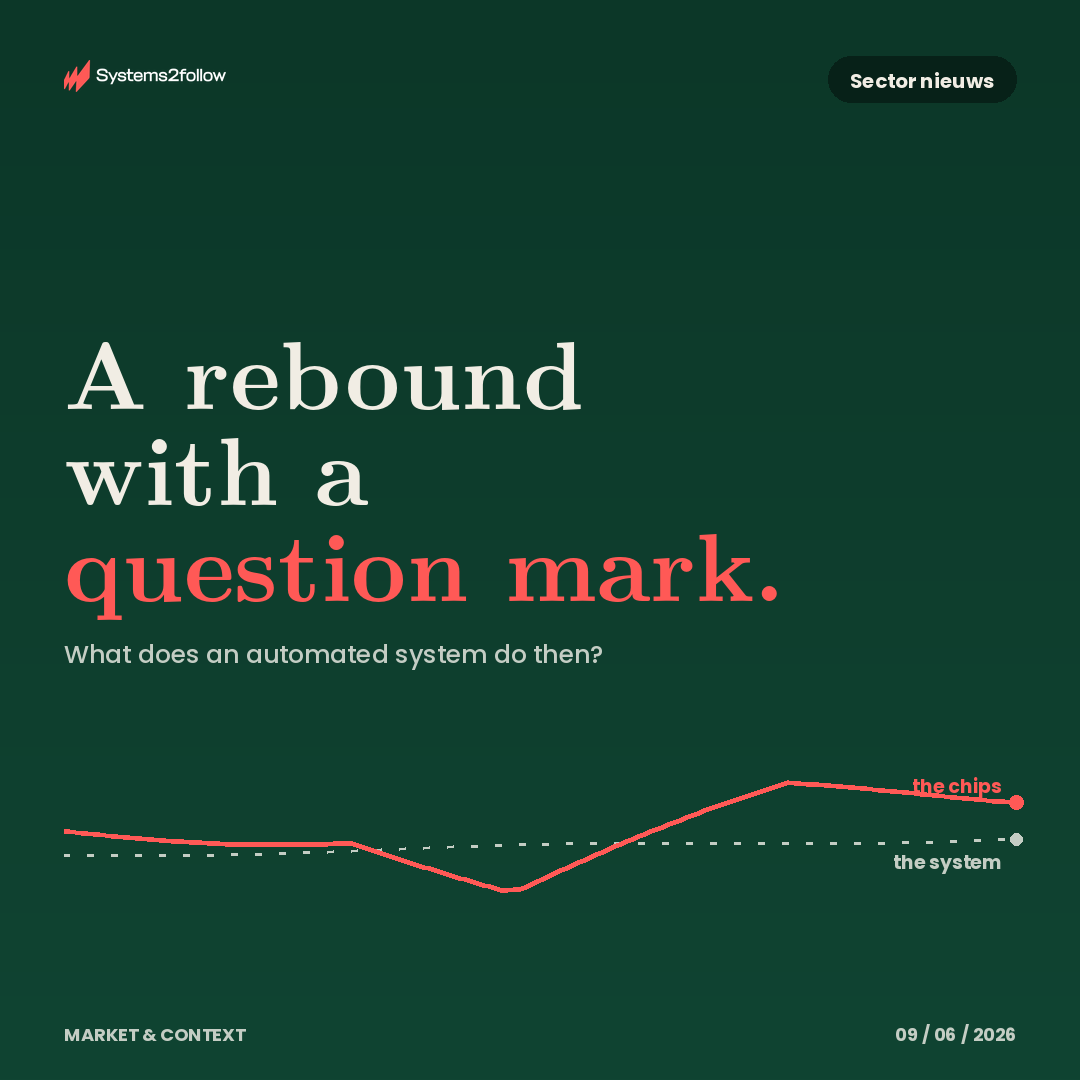
The trigger came on Friday, June 6. Chip giant Broadcom reported record quarterly sales, but coupled that with cautious expectations for the coming quarters. The market paid attention only to that second part. Disappointment spread throughout the sector. The widely followed semiconductor ETF (SOXX) dropped about 10% in one session, Micron plunged about 13%, and the Nasdaq Composite posted its steepest decline since April 2025, down more than 4% on the day. The broad S&P 500 lost around 2.6%.
Then came Monday, June 8, and the mood flipped. Chip stocks led the rebound. Micron rebounded roughly 5%, the semiconductor ETF jumped about 4%, and Nvidia rose more than 2% after announcing a partnership with South Korea's SK Hynix for next-generation memory chips. The Nasdaq closed about 1.4% higher at 25,929 points, and the S&P 500 ended at 7,405.
So in two trading days, the same handful of AI-related names pulled the index first down hard and then up again. That says something important. Much of the market movement now rests on a very small number of stocks, all around one theme. When that theme sneezes, the whole index catches a cold. And when it recovers, the index looks healthy again, even though little has changed structurally.
And the macro backdrop doesn't make it any calmer. A stronger-than-expected U.S. jobs report hounded interest rates and revived talk of a Fed rate hike rather than a cut. The market, meanwhile, is counting on a serious chance of at least one increase this year. The ECB and the Bank of England are meeting in the coming weeks. And tomorrow, Wednesday, June 10, comes the U.S. inflation (CPI) figure for May, a number that could again move the market significantly. Closer to home, the AEX is trading around record levels, while ABN AMRO has lowered its growth estimate for the Dutch economy in 2026 due to geopolitical tension. In short: plenty of reasons for an investor to feel the urge to act.
How does an automated system "see" this?
An automated system has no opinion about AI. It has rules.
Those rules look at things like price movement, volatility, volume, momentum and the interrelationship between markets. A human reads the news and thinks "this can't be going well." A system reads a price series and thinks, if we may put it humanly for a moment, "the trend is intact, the volatility is manageable, my signal is still valid."
That sounds cold, and it is. But that very absence of a story ensures that the system does not prematurely exit from an uptrend that may still run, and does not stubbornly hang on when the market actually turns. A weekend of anxious headlines is just data to a rule-based system. It measures it against criteria that were conceived, tested and approved long before this week.
Important: Not all automated systems react the same way. Two main flavors determine the difference.

Trend-following vs. market-neutral: the two extremes
Trend-following systems do what the name says. They identify a trend and ride it out. As long as the price moves in a certain direction, the position remains open. Only when the trend provably breaks does the system close the position.
In a week like this, a trend follower feels every outcome. The discipline lies precisely in not reacting to one bad Friday. It waits for evidence, not a feeling. The downside is that it never sells exactly at the top, because it doesn't know where the top is. In return, it also never takes profits too early. Over a multi-year bull phase, that has historically been the winning choice.
Market-neutral systems go long and short at the same time, aiming to be independent of market direction. They earn when certain relationships between stocks, sectors or indices behave as expected, not when the market as a whole rises or falls. In a week like this, they do nothing exciting: no celebration, no drama. And that is exactly the point. The moment the chip rally stalls once, and that moment will come someday, such a system is the stable factor in the portfolio.
Why the combination is usually smarter than the choice
The question we get most often is, "Which one is better?" The honest answer is: neither. It depends on the year.
In strong trending years, trending systems win convincingly. In messy, sideways years with lots of rotation between sectors, market-neutral systems win. Those with only one type experience the peaks as well as the troughs. Those who combine both experience a flatter ride and fewer sleepless nights.
That's not a marketing story. It's what our clients see in their own drawdowns, the moments when things briefly go wrong. A portfolio spread across strategy types usually recovers faster than a concentrated one, simply because not everything is wrong at once.

The real trap this week: yourself
It's tempting to get caught up in a week like this. After Friday, some investors think, "I'm building off, this is the beginning of something bad." After Monday's rebound, others think, "I'm adding some more, the AI trend is clearly not done." Both reactions are human, and both have the same root: overriding a system based on a feeling. With tomorrow's inflation rate in sight, that's even a feeling about an event that hasn't even happened yet.
The reason our clients choose automated investing is precisely to avoid this. A system doesn't know what a trillion dollars is. It doesn't know who SK Hynix is. It doesn't know what an AI bubble might be. It only knows what its rules say. Those are rules devised, tested and approved in advance by a trader who has made it his business.
The moment the market turns, that's not a disaster. That is the normal work of the system. What is a disaster is: going in with a feeling that in hindsight turned out to be based on a single headline, or an inflation figure that came and went.
What this means for you
Whether the current chip rally is a bubble or not, we won't know for sure for a few years. Some analysts say we are "maybe only halfway there." Others warn that a sector concentration like this rarely ended well in history. Both have arguments, and neither knows for sure.
What you can do now, however, is to arrange your portfolio so that the answer to that question arrives more gently. That means spreading out across strategy types, not going all-in on the theme that works today, and letting your systems do their job. Through Friday's decline, Monday's rebound, and whatever tomorrow's inflation number brings.
Investing involves risk. You may lose (part of) your deposit. Systems2follow offers only software and a Trading API that allows clients to link signals from traders to their own trading account with a regulated broker. We do not provide investment advice or manage assets. You are always responsible for your choices and linking through our API.
.jpg)